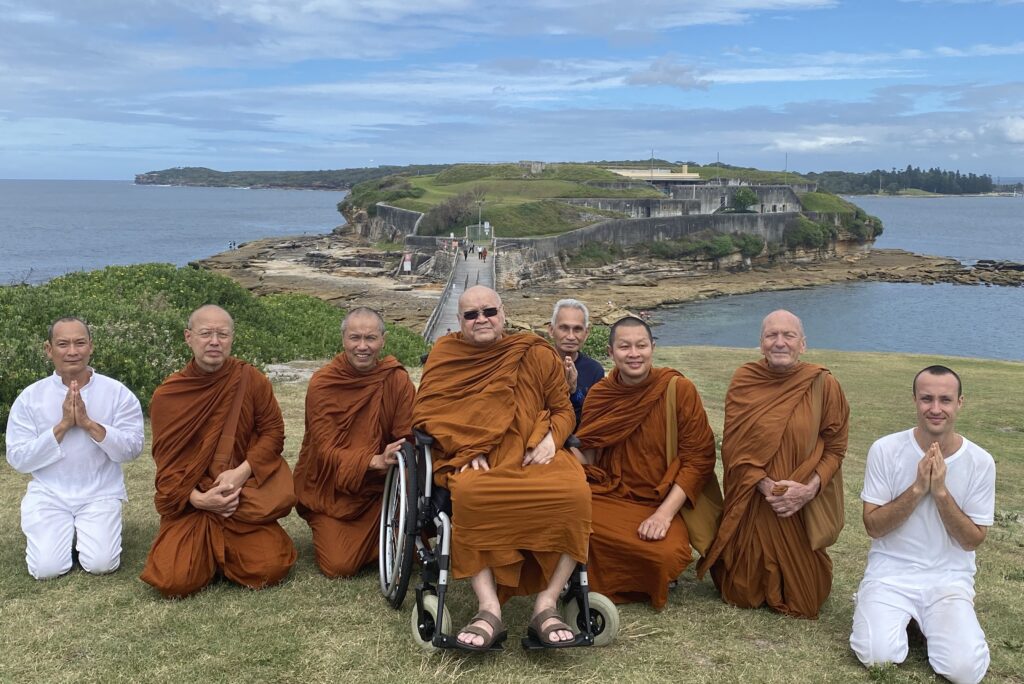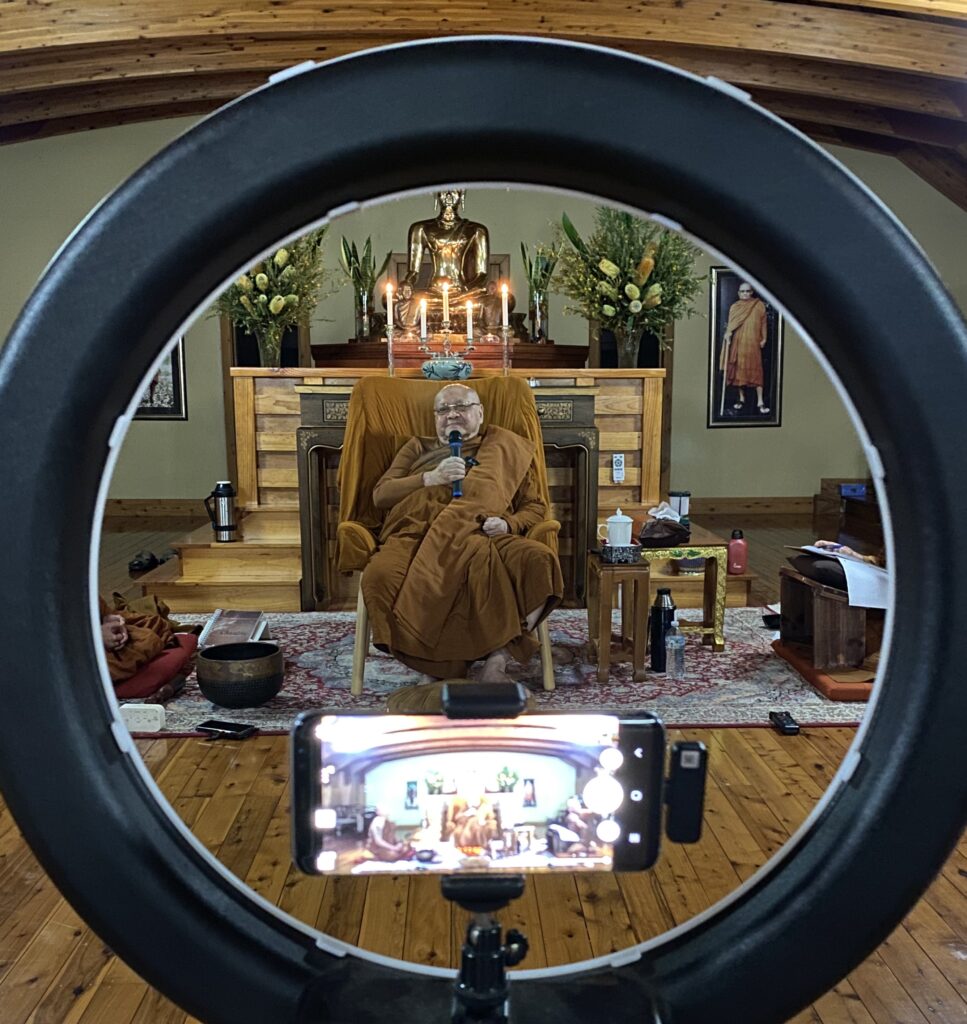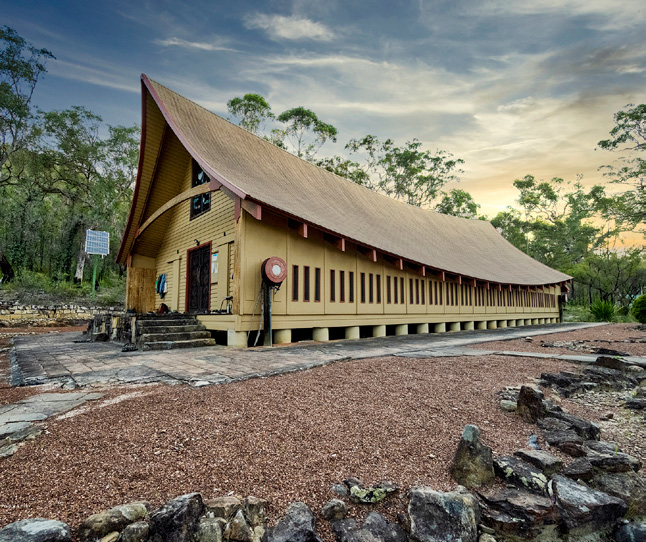
Our first calendar has been printed. A big thanks to Melinda and Marie. You can pick up a copy at the Wat on your next visit.
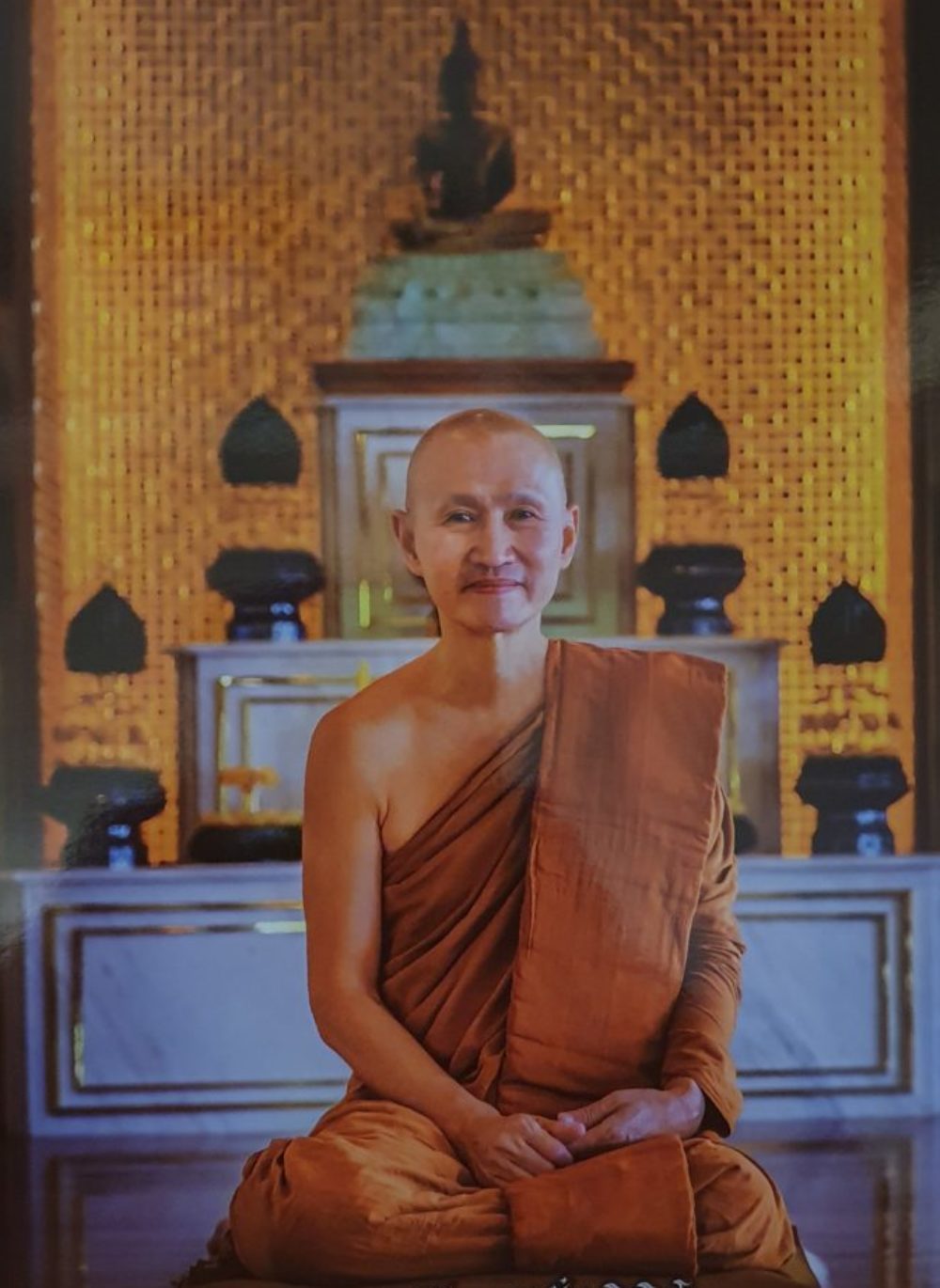
Our first calendar has been printed. A big thanks to Melinda and Marie. You can pick up a copy at the Wat on your next visit.
Greetings from Wat Buddha Dhamma;
I have not updated this Blog for some time, mainly because I have not been ‘rambling’ very much the last while. Following my trip to Indonesia last year, I have not left Australia and, since I am still waiting for results of my visa application, am not able to travel overseas.
Last year, following the Rains Retreat, I did, however, take a road trip with Ajahn Khemavaro and Anagarika Luke to visit one of the Buddha in the Bush properties in central north NSW near Bourke. This is a 10-hour drive from WBD but we took our time, staying overnight in the town of Dubbo. We also stopped at Lithgow in the Blue Mountains for a picnic lunch in the park, the spectacular Australian Fossil and Mineral Museum in Bathhurst and the Bornore limestone caves outside of Orange.
The second day we drove the short distance to the property at Byrock where we had our lunch beside the reservoir amongst the herds of feral goats, and 37C temperatures. This area is called ‘The Gateway to the Outback’ so is extremely dry although still having some scrub forest growing through the red clay.
We returned to WBD by the northern route passing through Bourke, Brewarinna, and Walgett, for an overnight in Narrabri to visit Mt. Kaputar National Park. The park is an old volcanic cone rising up to 1,500 m out of the surrounding flat plain. In the morning, we hiked through the Waa Gorge to a towering rock face and then visited the more famous Sawn Rocks, a tower of basaltic crystals beside a paved walkway.*
We headed to WBD the following day passing through the Upper Hunter weaving through the open-cast coal mines and then along a scenic valley next to Yengo National Park to Mangrove Mountain.
.jpg)
Bornore Caves, near Orange, NSW
In the earlier part of this year several senior Thai Ajahns visited. Ajahn Dtun opened the new monastery near Kempsey, Wat Buddha Metta; Ajahn Piak visited Wat Dhammacakkha near Brisbane and taught a weekend at WBD, and Ajahn Liam spent several days at WBD giving teachings to many of our devoted disciples. We also had short visits from Ajahn Karuniko from Chithurst Monastery and Ajahn Sukhacitto from Germany.
I was scheduled to offer some teachings at Ratanagiri in northern NSW, however, a cyclone blew in and my trip was cancelled. Just as well since flood and storm damage was quite extensive. I then arranged a visit towards the end of June, the Sunday workshop turning out to be a warm, sunny day with a keen group of meditators. However, for most of my time there it was cloudy and wet. I departed Gold Coast in a rain shower and thick cloud. Then, just as we flew over the Upper Hunter region the skies cleared and I could look right down into the gaping black pits of the coal mines which we passed the previous year. Then we passed over the rugged, thickly wooded Yengo National Park, crossed the Hawkesbury River at Wisemans Ferry – I could see the ferry crossing – over the yellow sand quarries of Maroota, and then into the suburbs of Sydney crossing the coast over the northern beaches with Sydney harbour and the CBD stretched out below, before banking west into Sydney Airport.

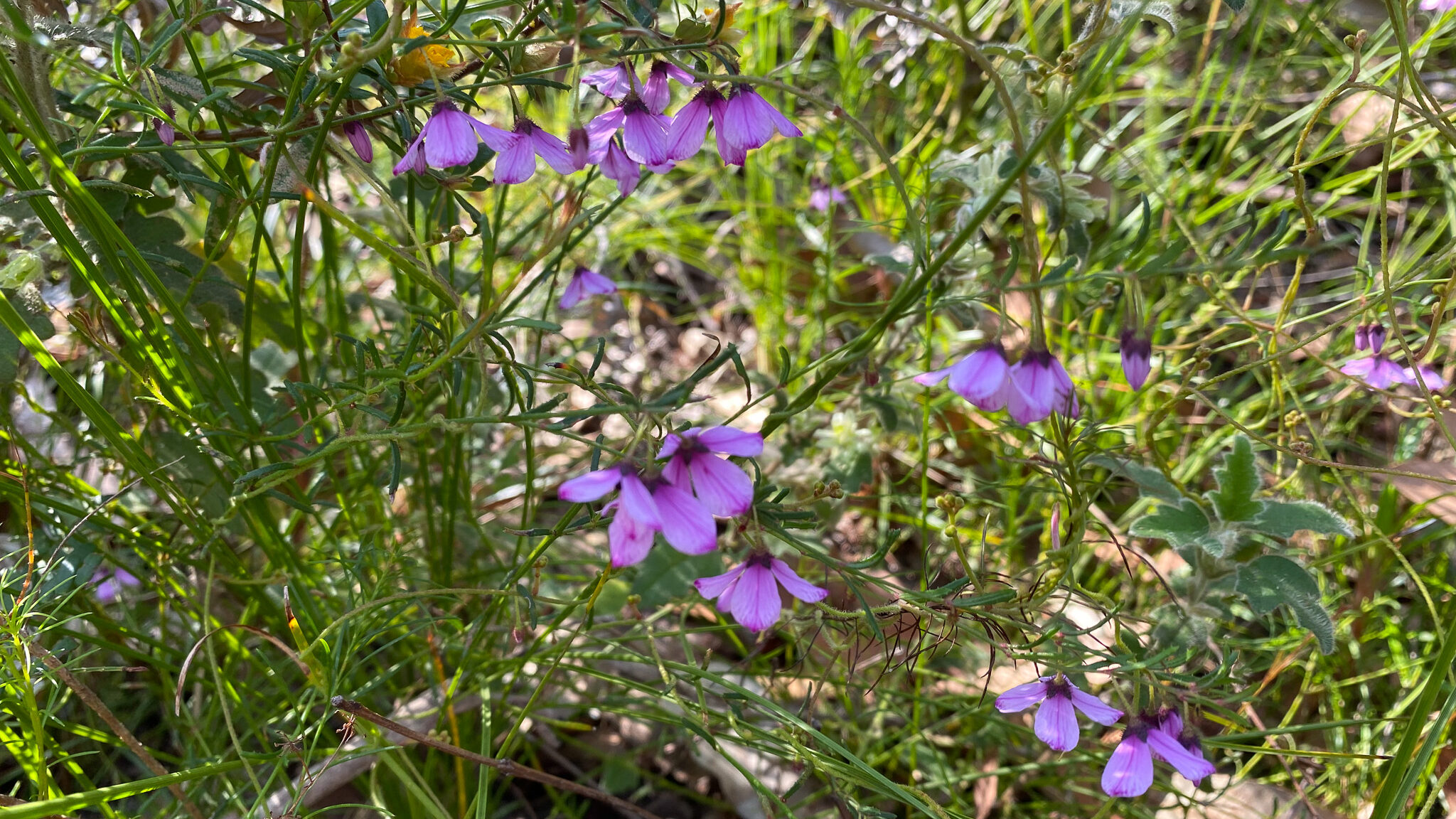
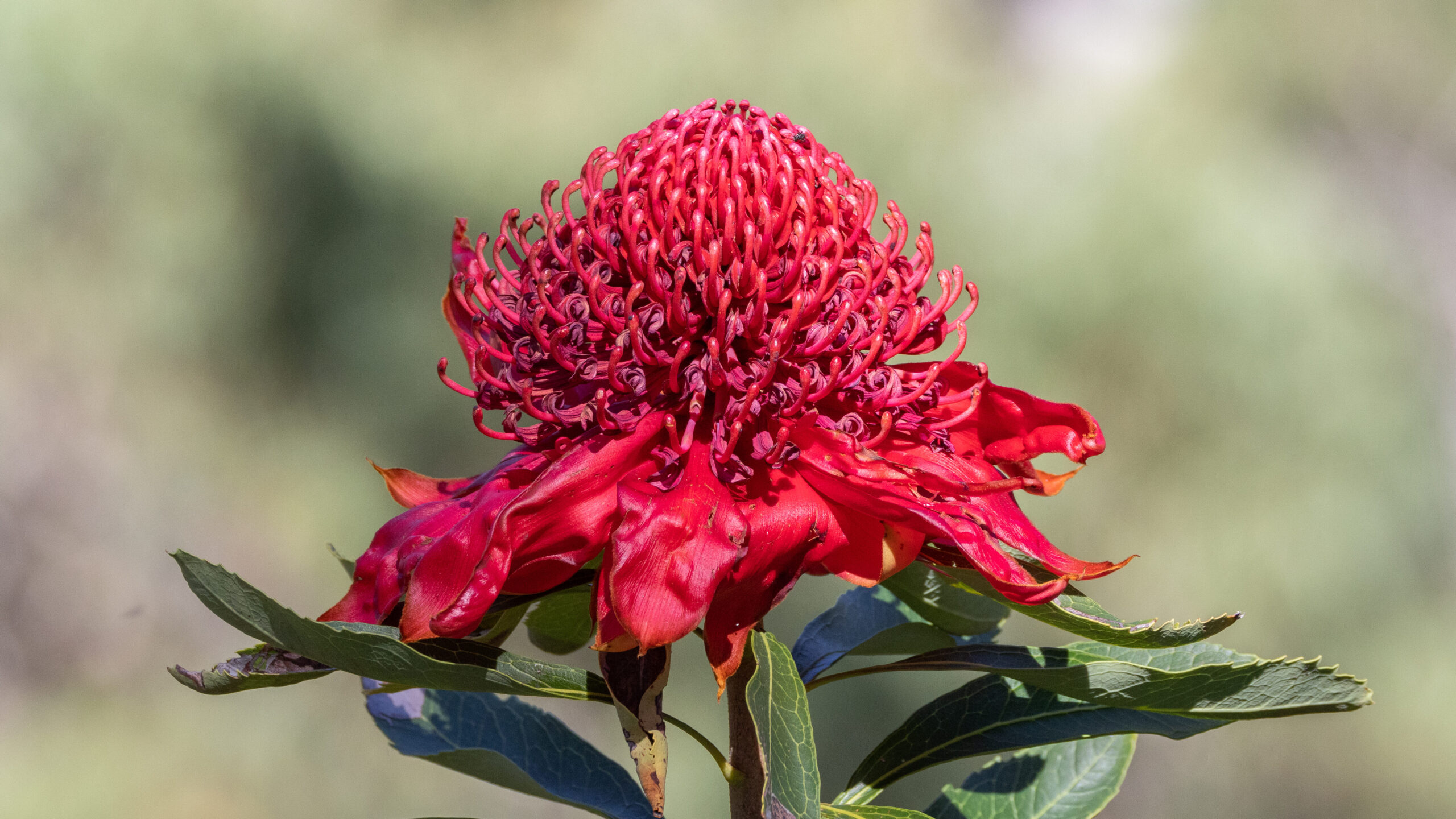
Wattle in bloom at WBD
The theme of my teaching at Ratanagiri, as well as that at talks at WBD lately, has been on selflessness or the practice of going beyond self-making. This is really the essence of the Buddha’s teaching and I think that it is important to keep this goal in mind to give us the right perspective on what practice is all about.
All aspects of the Buddha’s teaching of the Eightfold Path – Morality, Meditation and Wisdom – involve the practice of selflessness. We give up some of our personal urges to follow the moral standard, we give up personal mental habits to train the mind in meditation and we contemplate the nonpersonal nature of impermanence, unsatisfactoriness, and no permanent self to experience wisdom.
The point is to be able to develop these aspects of the path without bringing self into it. When we think about it, we may notice that this is really a lot easier said than done. How many times have we noticed ourselves thinking ‘Look how virtuous I am following these precepts.’, or ‘My meditation is going really well.’ Ideally, we do the practice, without being the practice. And, perhaps more importantly, we can work at selflessness at any time with selfless acts of kindness, generosity of time or a smiling ‘hello’, not to mention letting go of self-centered thoughts.
Many people believe that cultivating the spiritual qualities of generosity, morality and meditation lead them to some higher realm of existence. In essence, though, cultivating these qualities is really about creating a greater degree of selflessness, which is a higher realm of existence. When we are caught up with our selfish problems, isn’t that like being in a hellish realm? And when we can step out of our self-centered worries or forget ourselves for a while, isn’t that like heaven? The spiritual practices are merely a skillful means to realize selflessness, which is a higher realm of being.
When I lived with Ajahn Chah at Wat Pah Pong my main interest was to understand the special quality which caused him to be such a wise and skillful teacher. I recorded his talks and conscientiously translated them at my hut. I went to his hut many evenings to listen to his dialogues with various people and asked him my own questions. However, I was unable to discover his secret source of wisdom. Finally, after a critical period of confusion over his inconsistency in giving people answers, it dawned on me that really, ‘there is no Ajahn Chah’ as we usually conceive of him. In essence there was just mindfulness and wisdom functioning, and no permanent self behind it. In other words, the reason Ajahn Chah was such an exceptional teacher was because he was selfless – no permanent self manifesting, just the Dhamma functioning. With this realization I could then understand his inconsistency in responding to people because he was responding to the unique situation which they embodied and he responded to – different every time.
Similarly with us, if we can be more mindfully present with what is happening right now, without being preoccupied with our own self-interest and self-interpretations, we may notice that we are able to respond more accurately to what reality requires. Whenever we notice thought of ‘I’ or ‘mine’ arising, we can try to let them go and attune more to the way things really are.
Wishing you all progress on the path to selflessness.
Metta,
Ajahn Tiradhammo
*Some fine shots on YouTube ‘A Geological Wonder, Sawn Rocks – Mt. Kaputar National Park’ – Sawn Rocks at the start and Waa Gorge near the end.
MONASTERY REPORT
Comings & Goings
WBD
Monks
Wat Buddha Metta (WBM)
Dhammacakka Forest Monastery (DFM)
Retreats
New Year Retreat 2024-2025 with Ajahn Khemavaro was held in December. The next retreat is the 5-day New Year Retreat (28 Dec–1 Jan). To register, please see below. Easter Retreat dates will be confirmed later.
Potential Visits from Senior Monks
Ajahn Dtun plans to visit Australia in March 2026.
LP Piak also plans to visit WBD in 2026. More details will be available in March/April 2026.
Completed Projects 2025
Abbot’s kuti was finished end of 2024.
Upgrade of Solar Powered System (54 panels, 10 X 2.5 kW Lithium Batteries)
Building Projects for 2026
Earth work around Old Kitchen and Cynthia’s House
Decking and roof renovation for Cynthia House
Decking for Old Kitchen
The Wisdom of Stillness
5-Day New Year Retreat
with Ajahn Khemavaro
Sunday 28th December to Thursday 1st January 2026
To register, click on link:
New Year Retreat Registration
Vesak Weekend Retreat
with Ajahn Khemavaro
Friday 29th to Sunday 31st May 2026
Rains Retreat 2026
30th July to 23rd October
Rains Retreat at the Wat.
To serve and to deepen your practice.
Minimum stay of one month and priority will be given to those who can commit for the entire three months.
Recent Dhamma Talks on YouTube
Good Questions Good Answers
by LP Piak
Understanding the Stages of Samadhi
by LP Piak
Sutta Class 2: Right View: Finding the Roadmap to Life
by Ajahn Tiradhammo
Sutta Class 3: Causality: Finding the Root Cause of Suffering
by Ajahn Tiradhammo
How to be in Love with Life
by Ajahn Khemavaro
The Bliss of Stillness
by Ajahn Khemavaro
Picture Gallery:
Ajahn Dtun at Wat Buddha Metta 2025
Luang Por Piak 2025
A Time to Love
Devotion is from the heart; it’s not a rational thing. You can’t make yourself feel love or devotion just because you like the idea of it. It’s when you’re not attached, when your heart is open, receptive and free, that you begin to experience what pure love is. Loving-kindness, compassion, sympathetic joy, equanimity—these come from an empty mind; not from a sterile position of annihilating feeling, but from a heart that is not deluded, not blinded by ideas of self or others, or by passions of some kind or other.
When the heart is free from illusions of self, a loving quality arises in the pure joy of being. It’s not expected to last or be permanent. It is not to be made into anything. It’s just the natural way of things. So when you contemplate in that way, that is the way of faith and trust and devotion.
Excerpts from A Time to Love
Volume 3 of The Anthology by Ajahn Sumedho
To register for upcoming retreats, please register at Eventbrite or click on link attached to that retreat. For more info regarding the monastery, visit our website www.wbd.org.au. For further enquiries, please email wbdretreats@gmail.com or call the office at 0409-389-887 between 9 – 12 noon.
| Luang Por Piak to Visit Australia 26th February to 11th March 26th – 28th February Melbourne, VIC Saturday 1st March Visit Dhammacakka Forest Monastery in Forest Hill, QLD 2 – 4 pm For Directions: DFM Location Sunday 2nd March Dhamma Talk 6:30 – 8 pm Queensland Burmese Buddhist Association 159 Bagnall St. Ellen Grove QLD Friday 7th March Wat Buddha Dhamma Meal Time 10 am Dhamma Talk 7 pm Saturday 8th March Wat Buddha Dhamma Meal Time 10 am Q & A 7 pm Sunday 9th March Wat Buddha Dhamma Meal Time 10 am Dhamma Talk 7 pm Monday 10th March Wat Buddha Dhamma Meal Time 10 am Travel to Sydney The above schedule is subject to last minute changes depending on LP Piak’s health and energy. Please plan to arrive by 9:30 am for dana at 10. Any queries, please call the office at 0409-389-887 or email: wbdoffice@gmail.com. |
| About the Teacher: Luang Por (Venerable father) Piak is one of Thailand’s most respected teachers of Dhamma and meditation. Born in 1948, Luang Por Piak’s given name is Prasobchai but he was nicknamed ‘Piak’. As a child and young man Luang Por Piak did not have much interest in religion or meditation. It was when he was studying for his Masters in New York that Luang Por Piak began to develop an interest about the mind. The first time Piak began to develop an interest in his own mind was during the years in New York. On the subway, for example, while heading to work, he would find his mind naturally observing and converging on his breath. There he found both pleasure and peace. He also noticed that he was able to wake up in the morning at whatever time he wished simply by mentally determining the time the night before. Even if he’d spent most of the night at a party, he’d still wake up exactly at the predetermined time. These experiences made him curious about how the mind worked and led on to an interest in meditation. Venerable Piak then received full bhikkhu ordination from Luang Por Chah on July 3rd 1976, just before the beginning of the rains retreat that year. In 1981, when Venerable Piak had been ordained for five years, a piece of property was offered outside of Bangkok for a branch monastery. Luang Por Chah asked Venerable Piak to live there as the Abbot. It was unusual for a monk to be asked to take on so much responsibility at such a young age, but Venerable Piak had had quick progress in his Dhamma practice and was also native to that region. Initially surrounded by rice fields as far as one could see, within ten years his small monastery had been completely engulfed by Bangkok’s urban sprawl. Noise, heat and pollution notwithstanding, Luang Por Piak has remained a refuge of peace and soothing coolness within the heart of Thailand’s largest city. Although he never completed his masters degree, he quickly came to be recognized as one of the most respected masters of our time. Pictures of Luang Por’s Visit in 2024 Pictures of LP Piak’s visit in 2017 Pictures of LP Piak’s Visit in 2016 |
Sunday 27th October 2024
Arrival 9:00 – 10:00 am
Almsround & Lunch 10:00 – 12:00 pm
Ceremony 12:00 – 1:00 pm
Guided Tour 1:00 – 2:00 pm
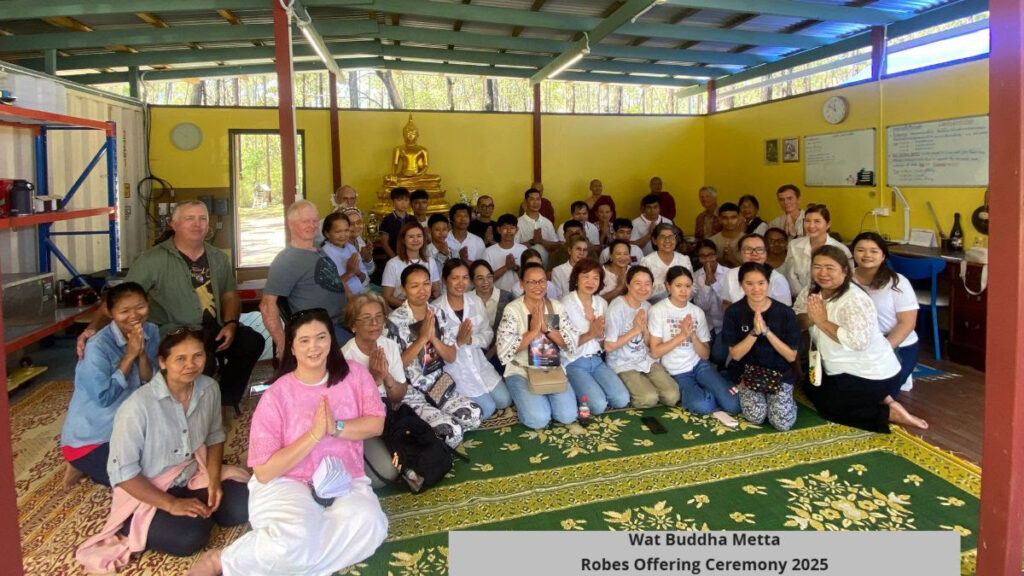
The Robes Offering Ceremony marks the end of the Rains Retreat. On this occasion we rejoice in having spent the past three months at the Wat dedicated to the cultivation of peace and kindness. This is a rare opportunity to take part in an old and inspiring Buddhist ceremony and a chance to connect with other practitioners.
The core values that are celebrated during the Kathina are those that make living together in harmony possible; qualities like kindness, compassion, patience and acceptance. In our sometimes confusing and competitive world, it is important to remember that our own sense of well-being cannot be secure unless it is founded on acts of generosity and goodwill to others.
The ceremony will include taking the Three Refuges and Five Precepts, auspicious chanting and Dhamma talks by Luang Por Tiradhammo and Ajahn Khemavaro. After the ceremony there will be a monastery tour, where visitors can see some monks’ huts.
For further info, please call 0409 389-887 between 8-10 am and 11am -1 pm or email: wbdretreats@gmail.com.
Robes will be available for offering at the monastery.
Community List for Rains 2024
Monks
LP Tiradhammo
Ajahn Khemavaro
Ajahn Bhuripanyo
Layguests
Luke
Annie
Tam
Rob
Rebecca
Kristine
Phil
Wisdom of Stillness
New Year Retreat
with Ajahn Khemavaro
Saturday 28th to Wednesday 1st January 2025
New Year Retreat Registration
For further enquiries, please email: wbdretreats@gmail.com or call the office at 0409-389-887 between 8 – 12 noon.
Recent Talks on YouTube:
Nourishing the Mind with Meditation
by Ajahn Dtun
True Happiness
by Ajahn Dtun
The Path to Arahantship
by Ajahn Dtun
Buddhism and Psychology
by Ajahn Tiradhammo
Letting Go Letting Be
by Ajahn Khemavaro
Freedom from Desire Not Freedom of Desire
by Ajahn Khemavaro
Doubts and other Demons
Q: What can I do about doubts? Some days I’m plagued with doubts about the practice or my own progress or the teacher.
A: Doubting is natural. Everyone starts with doubts. You can learn a great deal from them. What is important is that you don’t identify with your doubts. That is, don’t get caught up in them, letting your mind spin in endless circles. Instead, watch the whole process of doubting, of wondering. See who it is that doubts. See how doubts come and go. Then you will no longer be victimized by your doubts. You will step outside of them, and your mind will be quiet. You can see how all things come and go. Just let go of what you’re attached to. Let go of your doubts and simply watch. This is how to end doubting.
Q: These days, there seem to be so many teachers and so many different systems of meditation that it’s confusing. Which one should I follow?
A: It’s like going into town. One can approach from the north, from the southeast, from many roads. Often these systems just differ outwardly. Whether you walk one way or another, fast or slow, if you are mindful, it’s all the same. There’s one essential point that all good practice must eventually come to-not clinging. In the end, you must let go of all meditation systems. Nor can you cling to the teacher. If a system leads to relinquishment, to not clinging, then it is correct practice.
You may wish to travel, to visit other teachers and try other systems. Some of you have already done so. This is a natural desire. You will find out that a thousand questions asked and knowledge of many systems will not bring you to the truth. Eventually you will get bored. You will see that only by stopping and examining your own heart can you find out what the Buddha talked about. No need to go searching outside yourself. Eventually, you must return to face your own true nature. Right where you are is where you can understand the Dharma.
An excerpt from Still Forest Pool by Ajahn Chah


Ajahn Tiradhammo in Borobudur
Ajahn Tiradhammo celebrated Vesak in Indonesia in May. He also visited Borobudur for two nights.


Luang Por Piak visited New South Wales and Queensland in April
It was with great pleasure that we hosted Lung Por Piak, Ajahn Sprite, and Ajahn Mudito from 3rd to 11th April. Luang Por gave teachings at WBD, Dhamma Home, and Dhammacakka Forest Monastery in Gatton, Queensland.
Photo Gallery: Luang Por Piak 2024


Ajahn Dtun in Sydney from 12th to 18th March…and a Monastery is Born
It is with much joy and gratitude that we announce Ajahn Dtun has accepted a piece of land on the Mid Coast of New South Wales to be a branch monastery of Wat Boonyawad. The new monastery will be called Wat Buddha Metta. The land is a 1,250 acres of forest just outside of Kempsey NSW. The majority of the property is under a Biodiversity Stewardship Agreement, which helps to conserve habitat for native species and ecosystems. Tan Ajahn said that he plans to bring 2-3 monks with him when he returns in April 2025 to spend the Rains at Wat Buddha Metta.
Photo Gallery: Ajahn Dtun 2024
Upcoming Retreats and Events
Rains Retreat 2024
21st July to 18th October
Monks
Luang Por Tiradhammo
Ajahn Khemavaro
Ajahn Chaiyaporn–TBC
Ajahn Bhuripannyo
Lay people
Anagarika Luke
Annie
Tam
Robes Offering Ceremony
Sunday 3rd November
Activities include: Shared Meal, Auspicious Chanting, and Dhamma Talk 10 – 3 pm.
New Year Retreat
Wisdom of Stillness
5-Day New Year Retreat with Ajahn Khemavaro
Saturday 28th December to Wednesday 1st Jan 2025
Dhamma Talks on YouTube
The World is an Internal Thing
by Luang Por Piak
The Path to Arahantship
by Ajahn Dtun
True Happiness
by Ajahn Dtun
Nourishing Your Mind with Meditation
by Ajahn Dtun
Buddhism and Psychology
by Ajahn Tiradhammo
Putting the Teachings into Practice
by Ajahn Tiradhammo
Growing in Goodness
by Ajahn Khemavaro
True Wisdom
by Ajahn Khemavaro
Intoxications of Youth and Good Health
The Buddha taught that the unenlightened relationship to the agreeable aspects of life such as youth and good health, may be best characterized as a kind of intoxication. We take the good things in life for granted, forget their impermanent nature, and as a result, act, speak and think in ways that cause suffering to ourselves and others.
For this reason the Buddha taught us to constantly remind ourselves:
1. I am subject to old age. I am not exempt from old age.
2. I am subject to illness. I am not exempt from illness.
3. I am subject to death. I am not exempt from death.
4. Sooner or later, I will be separated from everyone and everything dear and agreeable to me.
5. I am the owner of my kamma, heir to my kamma; I have kamma as my origin, kamma as my relative, kamma as my support. I will be the heir of whatever kamma that I do, good or bad.
The strength of resistance we feel towards these reflections is a measure of the strength of the intoxication. It is dwelling on the truth that makes us sober and clear minded.
Excerpt from: From Heart and Hand Vol II by Ajahn Jayasaro
For more teachings of Ajahn Jayasaro, please click here: Teachings by Jayasaro
Empty Space
People want to go to Nibbana but when you tell them that there is nothing there, they begin to have second thoughts. But there’s nothing there, nothing at all! Look at the roof and floor here. Think of the roof as a “becoming” and the floor as a “becoming” too. You can stand on the roof and you can stand on the floor, but in the empty space between the roof and the floor there is no place to stand. Where there is no becoming, that’s where there’s emptiness, and to put it bluntly, we say that Nibbana is this emptiness. People hear this and they back up a bit. They don’t want to go. They’re afraid that they won’t see their children or relatives.
That’s why whenever we bless the laity by saying, “May you have long life, beauty, happiness and strength,” they become very happy. But if you start talking about letting go and emptiness, they don’t want to hear about it. But have you ever seen a very old person with a beautiful complexion or a lot of strength or a lot vitality? No! But we say, “Long life, beauty, happiness and strength,” and they are all pleased. They’re attached to becoming, to the cycle of birth and death. They prefer to stand on the roof or on the floor. Few are they who dare to stand in the empty space between.
Excerpt from A Tree in a Forest–A Collection of Ajahn Chah’s Similes
For more teachings of Ajahn Chah, please click here: Teachings in English
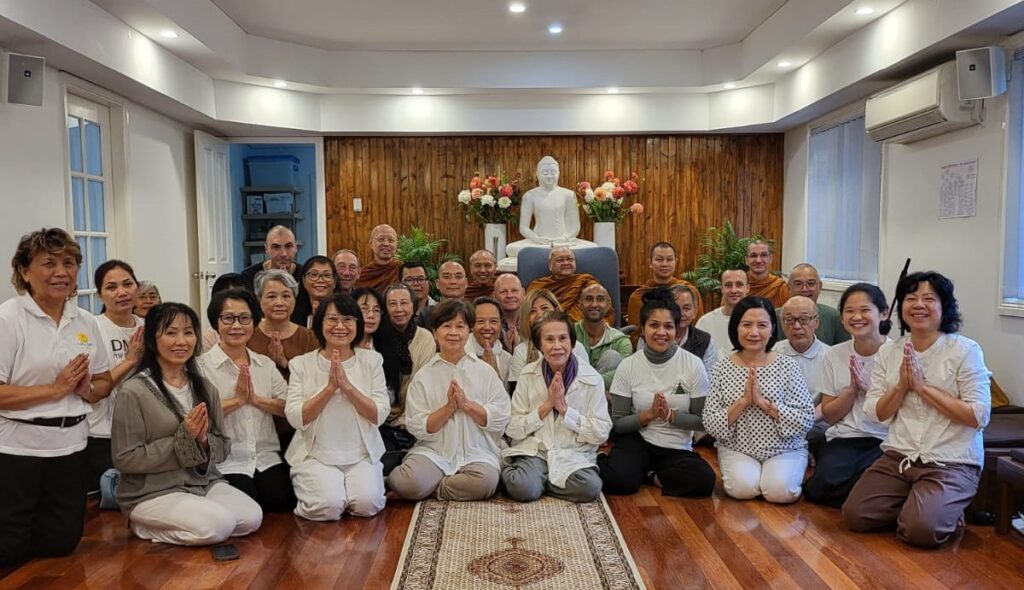
| Luang Por Piak in Australia from 5th to 11th April Friday 5th April Dhamma Home 204 William St Yagoona Dhamma Talk 10 am Meal 11 am Saturday 6th April Wat Buddha Dhamma Meal Time 10 am Dhamma Talk 7 pm Sunday 7th April Wat Buddha Dhamma Meal Time 10 am Q & A 7 pm Tuesday 9th April Visit Dhammacakka Forest Monastery in Gatton, QLD Paritta Chanting 1 pm Wednesday 10th April Dana at Dan’s House Dhamma Talk 10 am Meal Time 11 am Thursday 11th April Leave for Thailand The above schedule is subject to last minute changes depending on LP Piak’s health and energy. Please plan to arrive by 9:30 am for dana at 10. Any queries, please call the office at 0409-389-887 or email: wbdoffice@gmail.com. |
| About the Teacher: Luang Por (Venerable father) Piak is one of Thailand’s most respected teachers of Dhamma and meditation. Born in 1948, Luang Por Piak’s given name is Prasobchai but he was nicknamed ‘Piak’. As a child and young man Luang Por Piak did not have much interest in religion or meditation. It was when he was studying for his Masters in New York that Luang Por Piak began to develop an interest about the mind. The first time Piak began to develop an interest in his own mind was during the years in New York. On the subway, for example, while heading to work, he would find his mind naturally observing and converging on his breath. There he found both pleasure and peace. He also noticed that he was able to wake up in the morning at whatever time he wished simply by mentally determining the time the night before. Even if he’d spent most of the night at a party, he’d still wake up exactly at the predetermined time. These experiences made him curious about how the mind worked and led on to an interest in meditation. Venerable Piak then received full bhikkhu ordination from Luang Por Chah on July 3rd 1976, just before the beginning of the rains retreat that year. In 1981, when Venerable Piak had been ordained for five years, a piece of property was offered outside of Bangkok for a branch monastery. Luang Por Chah asked Venerable Piak to live there as the abbot. It was unusual for a monk to be asked to take on so much responsibility at such a young age, but Venerable Piak had had quick progress in his Dhamma practice and was also native to that region. Initially surrounded by rice fields as far as one could see, within ten years his small monastery had been completely engulfed by Bangkok’s urban sprawl. Noise, heat and pollution notwithstanding, Luang Por Piak has remained a refuge of peace and soothing coolness within the heart of Thailand’s largest city. Although he never completed his masters degree, he quickly came to be recognized as one of the most respected masters of our time. Pictures of LP Piak’s visit to Australia in 2017 Pictures of LP Piak’s Visit to Australia in 2016 |
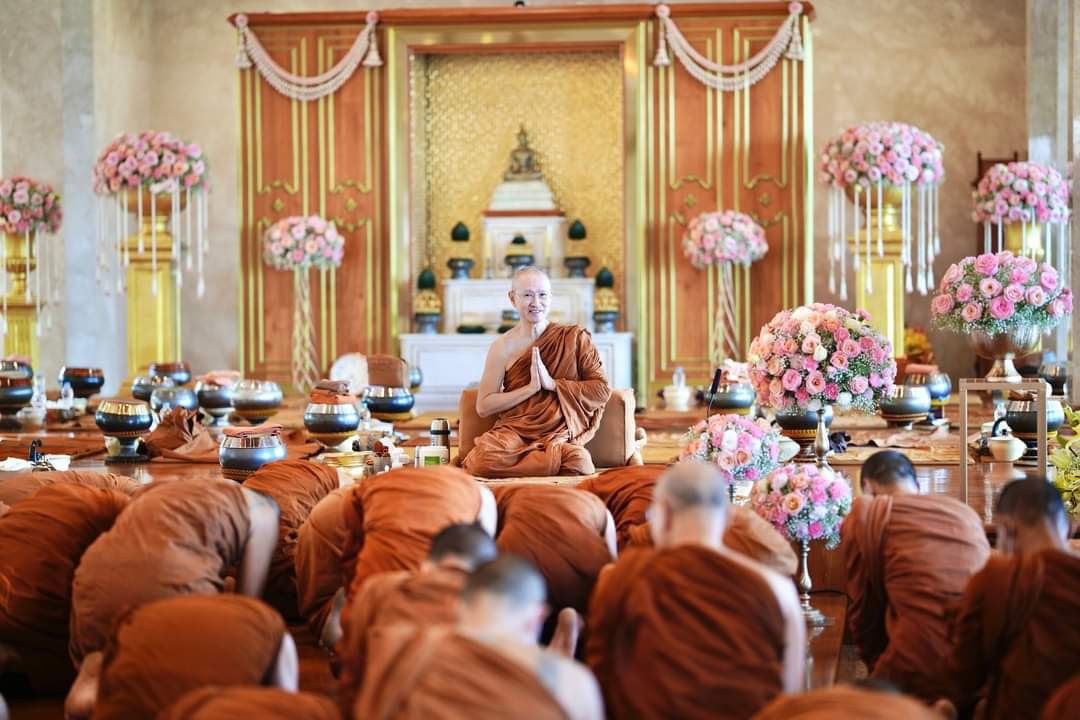
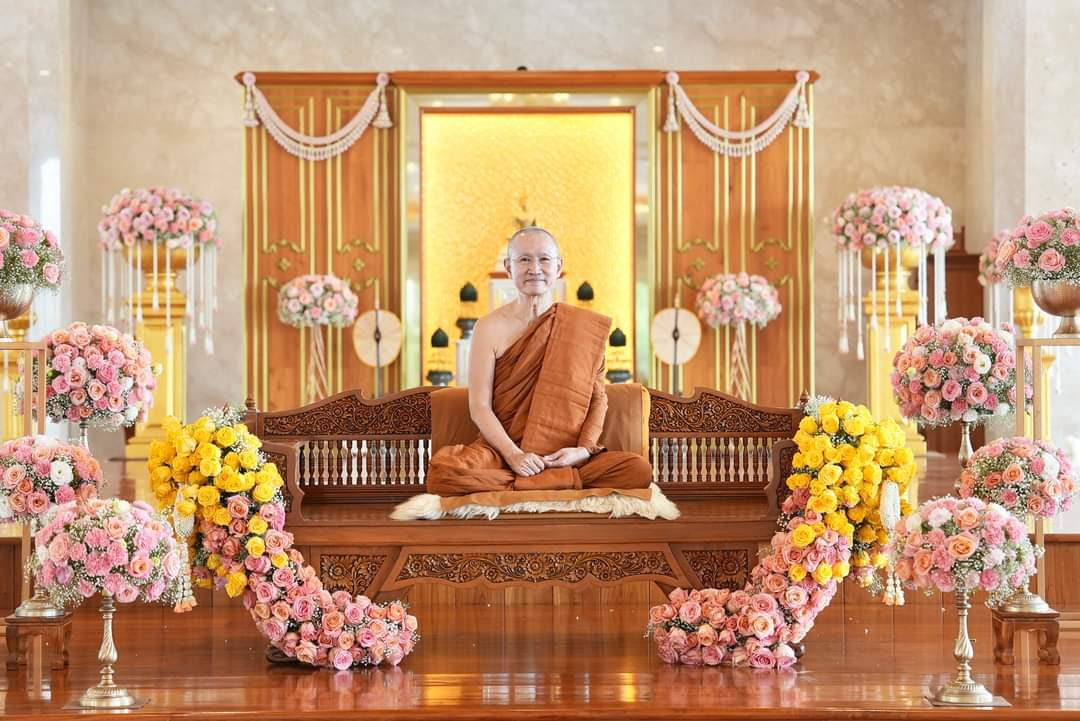
Ajahn Dtun, who is considered to be one of the greatest living Meditation Masters in Thailand, will be visiting Australia from 4th to 24th March
13th and 14th March at Wat Buddha Dhamma
Daily Schedule
9:00 Dana Offering
9:30 Meal Time
10:30 Q & A
For further info, please call the office at 0409 389 887.
Dhamma Talk at Buddhist Library
Sunday 17th March
6 – 8 pm
90-92 Church St Camperdown NSW
For more info, please call Buddhist Library at: 02 9519 6054
or email: blmanager@buddhistlibrary.org.
Ajahn Dtun will be in Victoria from 4th to 11th and 19th to 24th March
He will be staying Nigrodharama Forest Monastery
595 Seymour-Pyalong Rd
Hilldene VIC 3660
Daily Schedule
8:30 Dana Offering
9:00 Meal Time
10:30 Q & A
For further info, please call the Nigrodharama Monastery at 0480 271 789.
The schedule is subject to last minute changes and alterations.
Masks are required for visitors.
Past Teachings of Ajahn Dtun in Australia and US
Ajahn Dtun at BSV
10-Day Retreat in Melbourne 2007
Talks at Wat Buddha Dhamma in 2015
Talks in Melbourne in 2015
Talks at BSV in 2016
Talks in 2019
Talks at Abhayagiri Monastery 2013
Picture Gallery: Boonyawad Kathina
English Talks from YouTube
Stages of Enlightenment and the Mind
What Defines a Good Human Being: From Harming to Helping Others
For additional teachings in Thai or books/CDs, click on the links below:
Website
YouTube Channel
Facebook
The Sacred Equation
At the heart of the Buddha’s teaching is the Noble Eightfold Path, which is divided into the threefold training of sīla, samādhi and paññā, moral virtue, concentration and wisdom. The combination of all three path factors is commonly known as the Middle Way, and it is this very combination which forms a sacred equation that ultimately results in peace, freedom from suffering, liberation and Nibbāna. The three factors are mutually supportive of each other: moral virtue is a foundation for concentration, concentration the foundation for wisdom, and wisdom is the tool that works for one’s deliverance. Removing any one factor from this sacred equation will prevent one from reaching the path that leads to true happiness, Nibbāna.
The main part of this teaching begins with a very simple question which Ajahn Dtun asked a group of laypeople whom he knew to be students of a teacher who emphasizes the practice of ‘watching the mind’. This practice focuses on watching the arising and ceasing of all the objects of the mind’s awareness, with the view that this is the most effective way to give rise to wisdom and thereby cleanse the mind of the mental defilements. Those practising this particular method tend to overlook or underrate the role that concentration plays in the development of wisdom. Over the last 15 years this practice of watching the mind, while by no means new or modern, has attracted a great deal of interest and become very popular in Thailand. However, this new-found popularity has created concern among the more traditional forest masters, who stress that believing that the practice of just watching the mind can free it from the mental defilements is a great mistake. On many occasions over many years, Ajahn Dtun patiently gives advice to steer these practitioners back to the correct path of practice of moral virtue, concentration and wisdom, the Middle Way as taught by the Buddha. He also explains to practitioners that in no way whatsoever can concentration be taken out of the equation.
It is hoped that by reading this teaching the reader will gain a clear view of the complete path of meditation practice, and understand that solely contemplating the mind is not sufficient to free it from the mental defilements. The assumption that the mental defilements arise within the mind, and so must be dealt with solely by contemplating the mind, is true but not altogether correct. It is true that mental defilements do arise within the mind and so must be let go of within the mind, but it is not correct to believe that one can start the work of cleansing the mind at this point. This practice, as Ajahn Dtun clearly shows, is for those already highly advanced on the path to liberation, as they push forward to reach the final stage of enlightenment.
Preface from The Sacred Equation by Ajahn Dtun


2nd August to 30th October
During the Rains Retreat the community at WBD will focus on formal meditation practice, cultivating stillness, compassion, and wisdom. While people are welcome to visit the monastery during the day, we will not be able to accommodate overnight guests.
Emails will be answered between 5-7 days. If it’s urgent please call the office at 0409-389-887 between 11 am and 12 noon. Thank you for your support.
Community List
Monks
LP Tiradhammo
Ajahn Khemavaro
Bhante Siriratano
Ajahn Chaiyaporn
Venerable Bhuripannyo
Venerable Sammavaca
Venerable Caranadhammo
Nuns
Venerable Ajita
Layguests
Anagarika Annie
Bryce
Megan
Araliya
Luke
Lotus
Lionel
MarieW
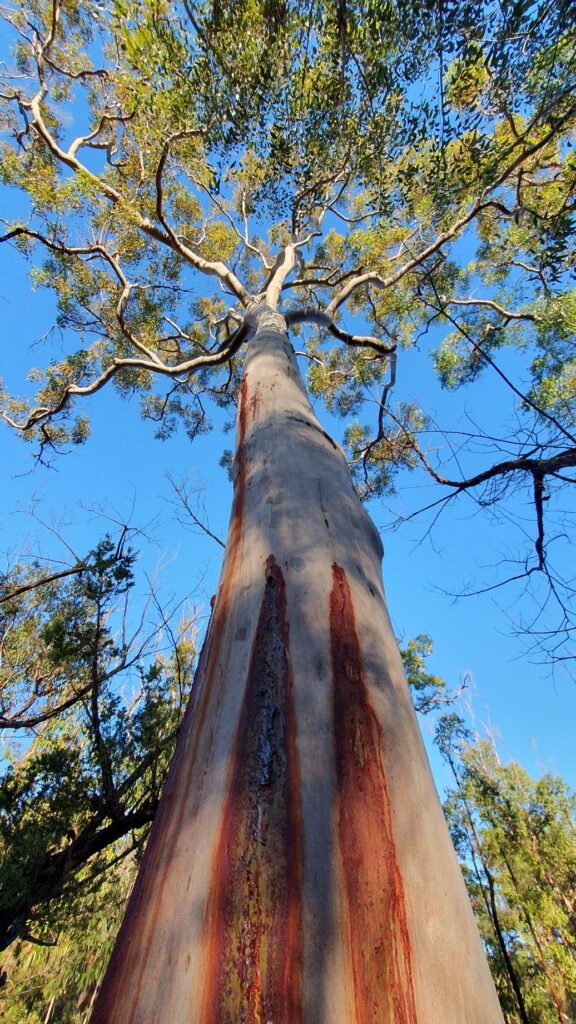
Kathina Ceremony
Sunday 5th November 2023
Activities include: Shared Meal, Auspicious Chanting, and Dhamma Talk
10 – 3 pm
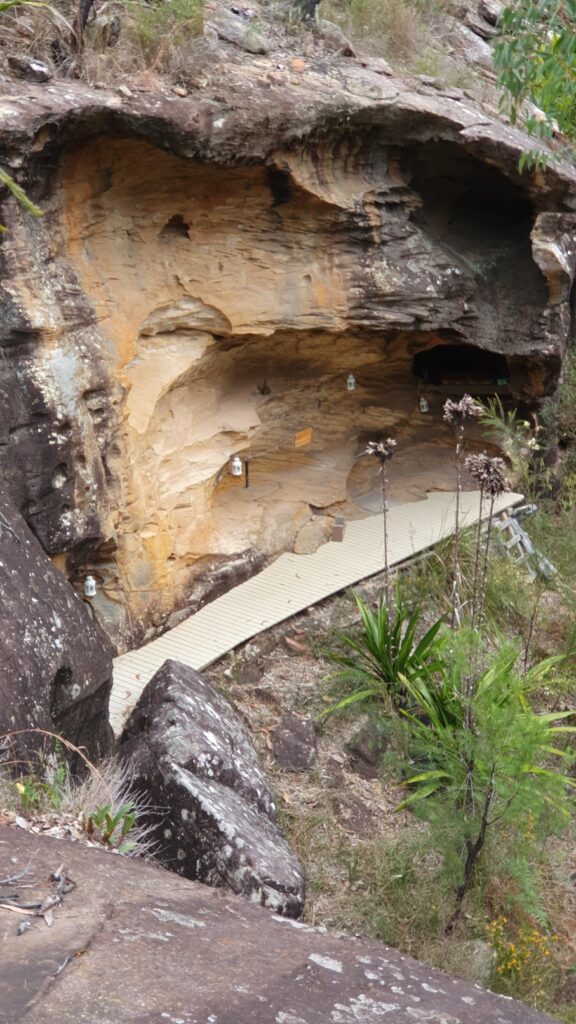
Reflection on Impermanence
All conditioned things are impermanent;
All conditioned things are dukkha;
Everything is void of self.
Life is not for sure;
Death is for sure;
It is inevitable that I’ll die
Death is the culmination of my life;
My life is uncertain;
My death is certain.
Indeed,
This body will soon
Be void of consciousness
And cast away.
It will lie on the ground
Just like a rotten log,
Completely void of use,
Truly conditioned things cannot last,
Their nature is to rise and fall,
Having arisen things must cease,
Their stilling is true happiness.
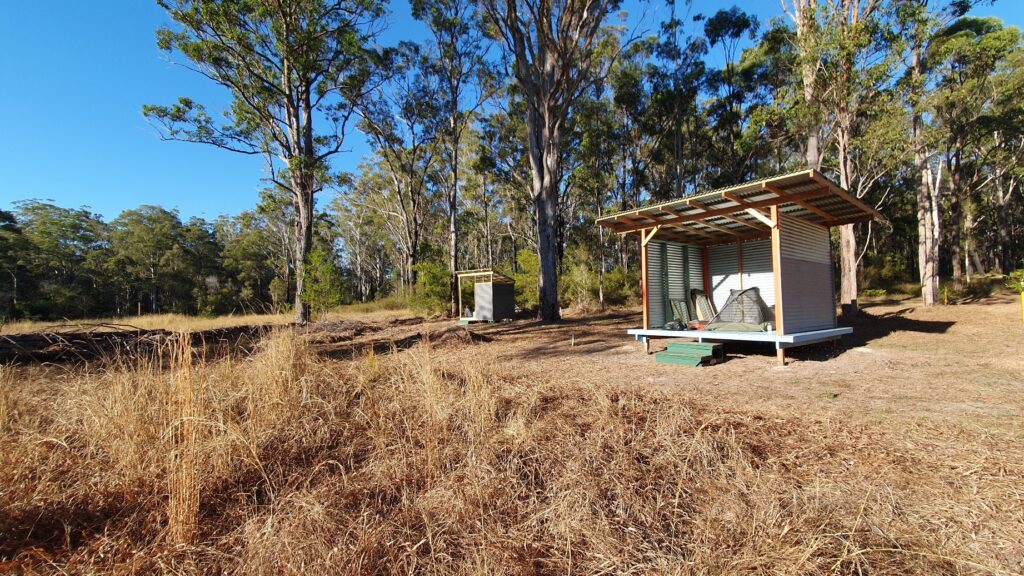
True and False Refuges
To many refuges they go–
To mountain slopes and forest glades,
To parkland shrines and sacred sites–
People overcome by fear.
Such a refuge is not secure,
Such a refuge is not supreme,
Such a refuge does not bring
Complete release from suffering.
Whoever goes to refuge
In the Triple Gem
Sees with right discernment
The Four Noble Truths;
Suffering and its origin
And that which lies beyond–
The Noble Eightfold Path
That leads the way to Suffering’s end.
Such a refuge is secure,
Such a refuge is supreme,
Such a refuge truly brings
Complete release from all suffering.
Dhammapada Verses #188-191